Search your Fruit

Custom Search
Showing posts with label * Rosaceae - Rose Family. Show all posts

Monday, November 28, 2011

STRAWBERRY

Common Name: Strawberries
Botanical Name: Fragaria x ananassa
Specimens From: USA
Specimens Weight: 18 gm [0.63 oz] (average wgt per fruit)

There are several species of strawberries. The most popular cultivated strawberries across the globe, is a hybrid species. It is a cross between F. virginiana (from North America, due to its great flavour) and F. chioloensis (from chile, due to its large size). Due to its popularity, many cultivars have been selected for commercial cultivation to suit different tastebuds, varies from sweet to tart.

Most strawberries are usually bright red when it is ripe. But there are also ripe strawberries and pineberries which are white, golden or slightly pinkish (not referring to those unripe but it is fully ripe). It is not easy to find it because most countries do not cultivate or sell it. The USA is still the leading producer of all types of strawberries.
Strawberry Butter Cookies

Strawberries are a good source of Vitamin C and antioxidants. Eat it fresh on its own or with cream or yoghurt. Or mixed with cake, pie, pancake, cookie etc.

And if you are wondering why the strawberry fruit have the seeds on the outside instead of inside, it is because those numerous "seeds [usually yellow]" are not seeds at all. It is an achene, which is a dry fruit itself that looks like a seed. The actual seed is inside the achene as every achene contains a single small seed. The spongy red flesh we love to eat, is not the fruit. It is just a ripened, enlarged "receptacle [swelling tip of a stem]" that bears many small fruits [achenes].

So we are actually eating the combinations of the spongy red flesh [receptacle], the numerous fruits [achenes] and the real seeds inside the achenes.


Fruit: Strawberries; Fragaria x ananassa; Rosoideae; Rosaceae.


View other fruits in the same family: Rosaceae [Rose Family].


Click here to view other types of fruits


Click here to add your favorite fruits

Wednesday, October 5, 2011

CRABAPPLE

Common Name: Crabapple
Vernacular Name: Wild apple
Botanical Name: Malus spp
Specimens From: China


Crabapples are usually grown wild or cultivated for their ornamental value rather than for their fruit. There are many species of crabapples that can be found in most cold climate countries. The general appearance looks similar to a domestic apple but much smaller in size. Crabapple is usually not more than 5cm or 2inches in diameter.

The skin can be yellow, green, red or combination of these colours. The small seeds are not edible, so discard it. But the taste is usually inferior as it is woody, tart or bland! In another words, it does not taste nice to eat it in its raw stage. Much better off when make into jelly and cider.


Fruit: Crabapple; Malus spp; Malinae; Maleae; Amygdaloideae; Rosaceae.


View other fruits in the same family: Rosaceae [Rose Family].


Click here to view other fruits in thumbnail images


Click here to have a say in your favourite fruits

Wednesday, January 7, 2009

NECTARINE (Yellow Flesh)

Common Name: Nectarine (Yellow Flesh)
Botanical Name: Prunus persica
Specimens From: Australia
Specimens Weight: 95 gm (average wgt per fruit)


Nectarines are native to China and are one of the oldest fruits around, dating back several thousands years ago. It is now the second most grown fruit trees worldwide, after apple, due to its favorable aromatic flavour.

There are thousands of cultivars but most of them are usually yellow with shades of red or pink on its smooth fuzz-less skin. Those with velvety fuzzy skin are known as peaches but they are actually of the same species as one single tree may produce both type of fruits.

Both types of the skin are edible. Its flesh is either white or yellow. White flesh is usually sweeter whereas the yellow flesh is more acidic but it may differ too depending on the cultivars. The photos shown above are the yellow fleshed nectarines. There is also another type with the unusual flattened shape, the pan tao or donut nectarine/peach.

As nectarines have fuzzless skin, they tend to look redder and also bruise easier than peaches. On size wise, nectarines are usually smaller than peaches.

Nectarines can be either clingstones or freestones, meaning that the flesh sticking to the stones or not. Most of the clingstone nectarines are meant for canning. Freestone nectarines are better off as fresh fruits.

There is a single brown seed encased in a woody pit or stone. The seed tastes bitter as it contains cyanide. Avoid eating it as it is harmful when taken in large doses.


Nectarine; Prunus persica; Amygdalus; Prunoideae; Rosaceae.


View other fruits in the same family: Rosaceae [Rose Family].


Click here to view other types of fruits


Click here to add your favorite fruits

Sunday, November 9, 2008

PEACH (White Flesh)

Common Name: Peach
Botanical Name: Prunus persica
Specimens From: China
Specimens Weight: 276 gm (average wgt per fruit)


Peaches are native to China and are one of the oldest fruits around, dating back several thousands years ago. It is now a very popular fruit worldwide, due to its favorable aromatic flavour.

There are thousands of peach cultivars but most of them are usually yellow with shades of red or pink on its unmistakable velvety fuzzy skin. Those with fuzz-less skin are known as nectarines but they are actually of the same species.

Both types of the skin are edible. Its flesh is either white or yellow. White flesh is usually sweeter whereas the yellow flesh is more acidic. The photos shown above are the white fleshed peaches. There is also another type with the unusual flattened shape, the pan tao or donut peach.

There is a single brown seed encased in a woody pit or stone. The seed tastes bitter as it contains cyanide. Avoid eating it as it is harmful when taken in large doses.

Peaches can be either clingstones or freestones, meaning that the flesh sticking to the stones or not. Most of the clingstone peaches are meant for canning. Freestone peaches are better off as fresh fruits.


Peach; Prunus persica; Amygdalus; Prunoideae; Rosaceae.


View other fruits in the same family:Rosaceae [Rose Family].


Click here to view other types of fruits


Click here to add your favorite fruits

Sunday, February 3, 2008

HAWTHORN - CHINESE HAW


Common Name: Chinese Haw
Vernacular Names: Shan Zha
Botanical Name: Crataegus pinnatifida
Specimens From: China

Chinese haw is just one of the many species in the hawthorn group of fruits (Crataegus genus). It is found mainly in China and Korea.

Chinese haw is a small fruit, about the size of a small crabapple. It is red and dotted with numerous small light brown spots. There are four to five odd shape seeds, clustering mostly in the center of the fruit.

It can be eaten out of hand. It has a mealy texture and tastes slightly bitter and sour. The skin is edible but it is even more bitter. Also available in the jar form where the fruits are preserved in sweet syrup.


Chinese Haw, Dried

There are also the sun-dried, slices of haw which are used in drinks or cooking.


Chinese Haw Drink
Put five to ten slices of haw in a glass and pour boiling water into it. Cover it and let it simmer for about fifteen minutes to get the full aroma out of the dried haws.

You may also add dried red dates and/or goji berries to sweeten it. Or add chinese tea or any tea leaves to make a hot haw tea instead.


Haw Flakes, Haw Jellies, Haw Balls
Various haw candies shown on the left. The ever popular "haw flakes" that comes in several disc sizes. The "haw jelly" also comes in several shapes and is a little soft, like jelly when you bite on it. And the "haw ball" which is round like a marble and it is coated with sugar. It is the sweetest of the three type of candies.

During winter, the candied skewer version is extremely popular in Northern China. About ten fruits are skewed on a bamboo skewer and coated with boiled, hardened sugar. Needless to say, it is very sweet!

Chinese haw is traditionally used in improving blood circulation, digestive aid and slimming diet (claimed), among the several medicinal usages.


Fruit: Chinese Haw; Crataegus pinnatifida; Malinae; Maleae; Amygdaloideae ; Rosaceae.


View other fruits in the same family: Rosaceae [Rose Family].


Click here to view other types of fruits


Click here to add your favorite fruits

Monday, January 28, 2008

POMELO (Green Skin/Pink Flesh)


Common Name: Pomelo
Vernacular Names: Pummelo, Shaddock, Chinese grapefruit
Botanical Name: Citrus maxima
Specimens From: Thailand
Specimens Weight: 1 kg [2 lb 2.7 oz]

Pomelo is the biggest citrus fruit, with some bigger than a soccer ball. It is native to South-east Asia and is now widely cultivated in many Asian countries and also in the Pacific. Pomelo is extremely popular during the Chinese lunar new year.

Pomelo is huge and tipping the scale, way above 5 kg is not uncommon. The specimen fruit photo shown is considered as 'mini' size.

The shape is usually slightly pear-shape or round. The skin color ranges from green to yellow. You can eat it even when it is green. The pulp can be clear, pale off-white, pink or almost red.

Eating pomelo takes a bit of effort as the skin is extremely thick but spongy. Use the tip of a sharp knife to make a one inch deep incision vertically down, from top to the bottom of the fruit. Repeat a few times round the fruit and peel off the skin slowly (refer to photo).

The taste is mildly sweet, aromatic and usually, does not have the strong acidic taste found in grapefruit. But do not bite on the membranes (the translucent segments containing the teardrop sacs) as it is very bitter. Most of the cutivars have only a few seeds but some of them can be seedy.

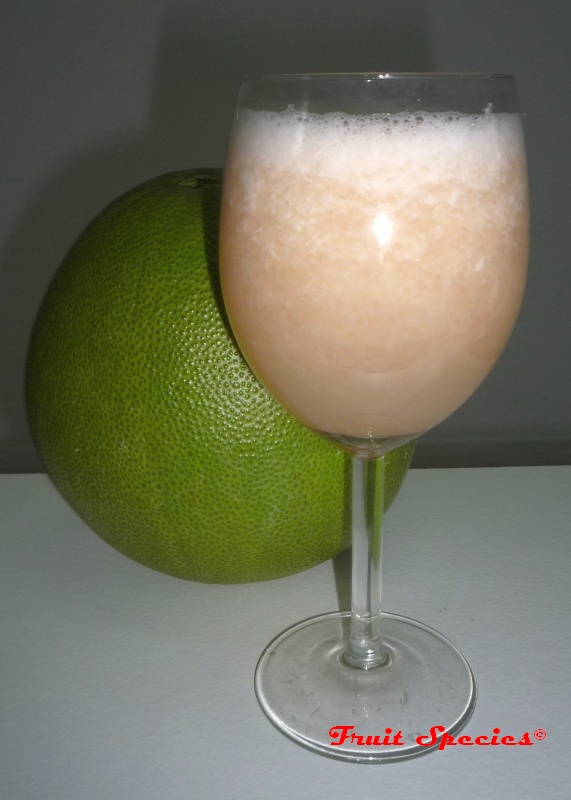
Pink Pomelo Juice

If you prefer to drink it, you may have pomelo juice! You may add sugar to sweeten the taste as pure pomelo juice may be slightly bitter.


View other fruits in the same family: Rutaceae [Citrus Family].


Click here to add your favorite fruits


Or click on any of the fruit thumbnails to go to that page: